Decision Cube
- Focus
- Product · interaction · motion
- Year
- 2026
- Status
- Local prototype
Making a decision-making style visible. A cube becomes a picture of a person, with motion and simple interactions connecting their choices to a fuller understanding of themselves.
01 / The cube transformation
More sides to you.
The cube is you. Hidden faces become visible, open out and align. Every dot stays with its face.
Static scenes · choose a stage to explore the transformation without animation.
02 / The personality type mixer
Same priorities.
Different starting point.
One swap explains why order matters. Choose what leads, add another priority, then turn the combination around.
Order makes a difference. Try turning the combination around.
Pragmatism + Principle
Meet the
Pragmatic Idealist
How they decide
They move toward what works, but 'works' carries a longer time horizon than most people use — a solution that wins today but costs trust or integrity down the line doesn't clear their bar. They're comfortable in the mess of reality and allergic to abstraction, except when it comes to the things they won't compromise on, which are non-negotiable and don't require a meeting.
What they bring to a team
They're the person who finds the actual path through — not the ideal path, not the cautious path, but the one that moves things forward without leaving wreckage behind. When trade-offs have to be made, they make them, and the team can trust that whatever decision comes out has been tested against both what's possible and what's right.
Working well with them
Come with the real constraints, not the polished pitch — they're better at navigating the actual situation than validating a tidy one. If a proposed shortcut touches something they hold as a line, they won't be argued out of it with efficiency logic; find a route that doesn't require crossing it.
03 / The interactive result explanation
A result you can
see the reasons for.
Colour connects the choices, counts and words. Select a dot or a priority to see what contributes to the result.
One dot = one chosen option.
Colour shows its tagged priority.
3 of 8 choices
Why “Pragmatic”?
These choices favoured a workable response to the situation. This is the most frequent priority in the example choices.
Pragmatism contributes “Pragmatic” to Pragmatic Idealist.
Each chosen option adds one count. The two most frequent priorities select the type and its description. These are counts of fictional choices, not percentages of a personality.
04 / The shareable type film & cards
A little introduction.
A moving identity.
A portrait film and matching card carry the type beyond the result screen. The same visual language, ready to share.
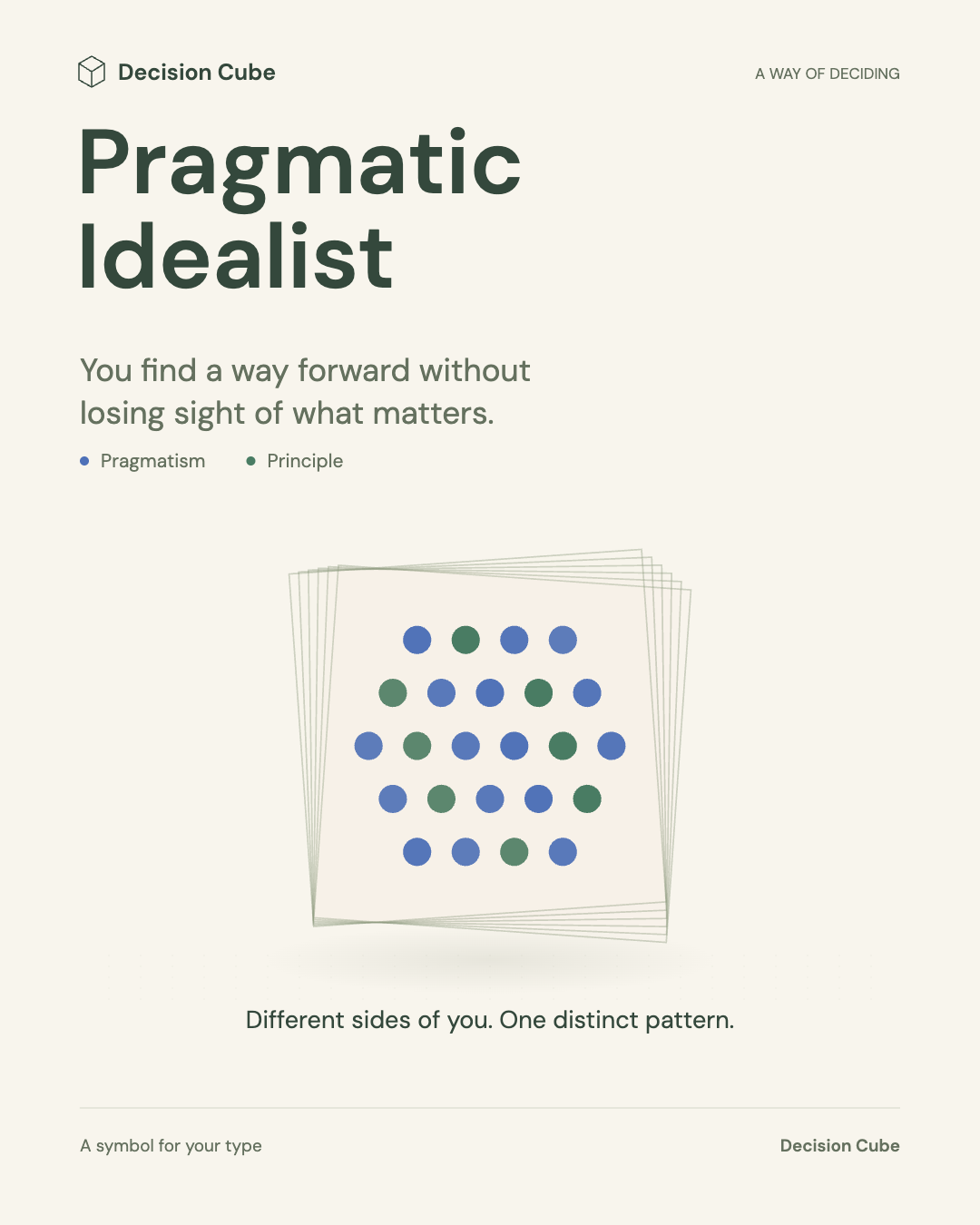
Explore the artwork on its own
A shared symbol for the Pragmatic Idealist type. Its dot proportions are decorative, not personal scores. The eight-choice example above shows actual counts from fictional choices.