Understand the workflow
AI Workflow Audit
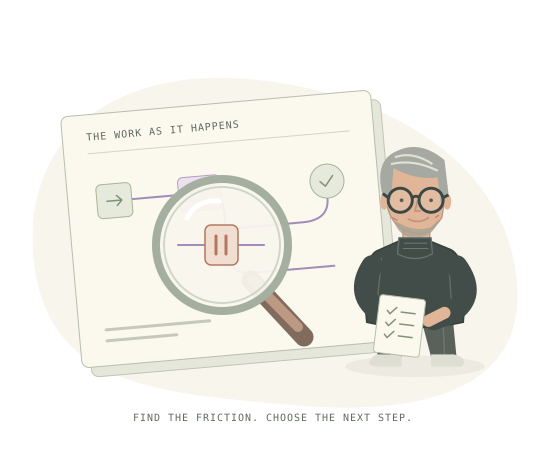
Map one recurring process, locate friction and risks, then return ranked recommendations and written next steps. The designed service gives a team a bounded decision before it commits to a build.
Aran Labs Studio / Selected work / 2026
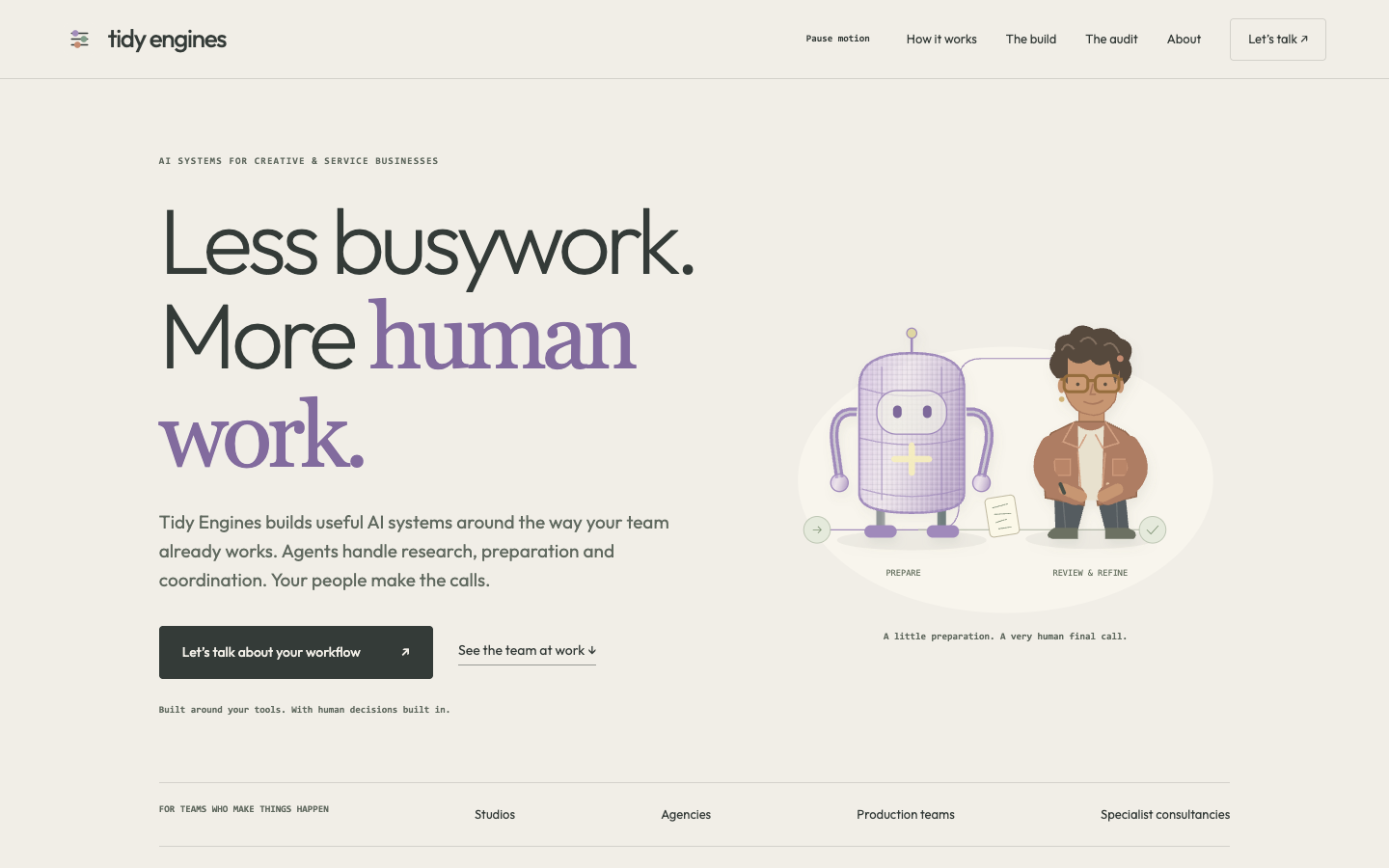
Creative and service teams spend hours preparing the work around their work. We shaped Tidy Engines’ service model and built its website to explain where agents could help, who owns each decision, and how to start with one workflow.
The business problem
A producer assembles the same project folders. A studio gathers research before every proposal. A specialist checks a shortlist before it reaches a client. These recurring handoffs are the starting point for the service—not a reason to automate every decision.
Understand the workflow
Map one recurring process, locate friction and risks, then return ranked recommendations and written next steps. The designed service gives a team a bounded decision before it commits to a build.
Implement an agreed change
The proposed delivery model covers one workflow, including discovery, connections to agreed tools, testing, controls, documentation and handover. Software costs and ongoing support are scoped separately.
These are designed service offers. This project covers their positioning, website, illustrated workflow examples and enquiry experience.
02 / Interactive storytelling
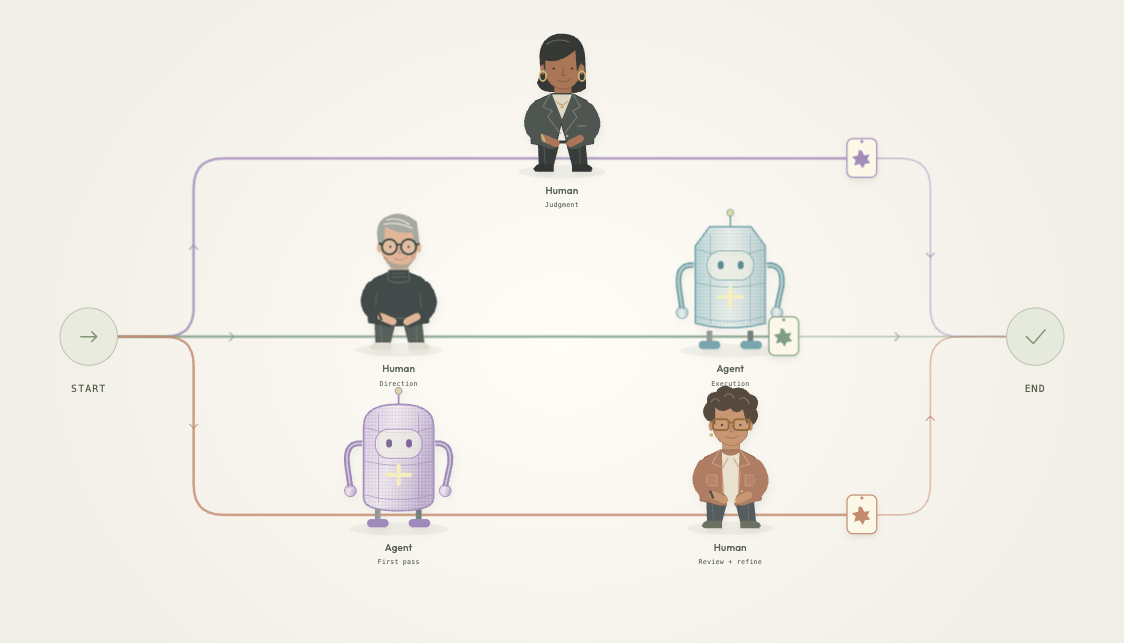
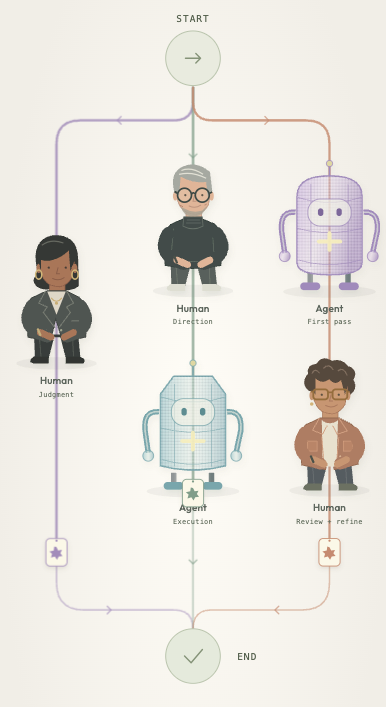
The designed workflows distinguish human judgment, human direction and human review. Choose a route to follow the handoff, then pull back to see a connected team. This is an interactive explanation of the service model, not a running agent network.
Human judgment: Start → person → end. A person handles work that depends on judgment or relationships.
Human direction: Start → person → agent → end. A person sets the brief and boundaries; the agent carries out the agreed work.
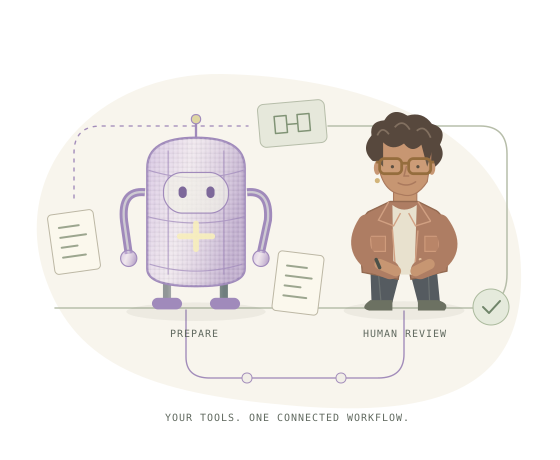
Human taste: Start → agent → person → end. An agent prepares the first pass; a person reviews and refines it.
The network reveal: The view pulls back to show more connected teams. A dotted “Where we started” frame identifies the original three routes.
A concrete first journey
A studio lead explores a brief-to-proposal example: a person sets direction, an agent prepares source-linked material, and the team shapes the proposal. This workflow is designed, not connected to client tools.
The audit and build pages explain scope, deliverables, exclusions and questions to resolve. Separate pages make it possible to discuss one bounded service rather than an undefined AI transformation.
The working contact helper carries the chosen interest into a browser form, validates the brief and prepares an email draft. The visitor reviews it before opening their email app or copying it. The website does not send or store the enquiry.
A draft arrives at the reviewer. Rough marks become a star as the hands move, then the finished document continues.
Original handoff detail, enlarged. Plays once; replay to watch again.
03 / The human checkpoint
The document pauses beneath the reviewer’s hands. Rough marks resolve into a star, with a small movement of the hands marking the change. Human refinement becomes a visible event in the workflow.
04 / Illustration system
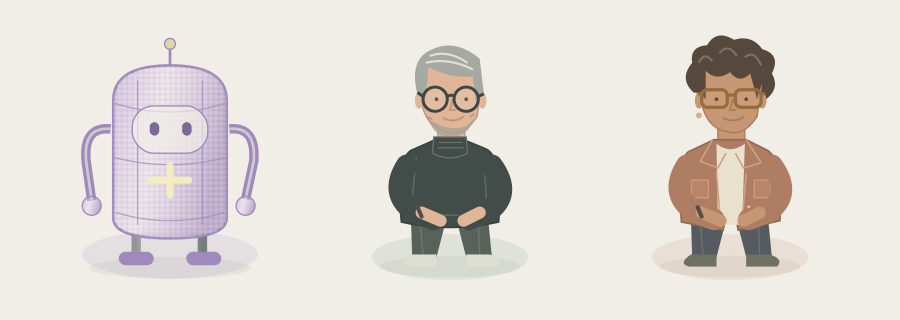
Woven surfaces make the robots feel tactile. Hair, glasses and clothing give people individual presence. Fine lavender, sage and terracotta lines connect them without overpowering the characters.
05 / Across screen sizes
Desktop paths run across the page. Mobile rebuilds them as three vertical branches. Motion can be paused; reduced-motion preferences open a complete, still network, with every route available as a static view.
What we delivered
Distinct people and woven agents give each handoff an owner. A pause beneath the reviewer’s hands marks a decision, rather than presenting every step as automatic. The drawings explain how the service is intended to work.
The contact helper prepares text locally and exposes a reviewable draft. There is no submission endpoint behind it. That matches the current business stage and avoids collecting workflow details into an unfinished system.
A static build produces the offer, example, contact and information pages with local fonts and artwork. The workflow redraws for narrow screens, supports pause and reduced motion, and has a text description. Visitors can understand the service without following animation.
Aran Labs delivered service positioning, offer pages, designed workflow examples, illustration, interactive motion, responsive layouts and the enquiry-draft helper.