the shift
After a year as Creative Director at Vana, I'm stepping back from the full-time role to focus on my studio, Aran Labs.
But first, let me start somewhere else.
For most of my career as a designer, I've felt a specific frustration: not being able to build the things I could envision. I could concept a product. Design it. Art direct every pixel. But shipping it required an engineering team, a co-founder, funding, months of waiting. I had the ideas but not the tools.
That wall came down this year.
the wall coming down
I've been turning the processes we run inside the studio into standalone products. Our brand onboarding workflow, the structured intake and strategy process we use with every new client, is becoming a tool that other studios and founders can run themselves. Our content amplification system, which takes a single long-form piece and generates platform-ready derivatives across multiple voices and channels, is becoming its own product too.
These aren't speculative product ideas. They came from real friction. Frustrations I kept noticing in client work, in collaboration, in my own routines. The difference now is I can validate them with a working V1 in weeks (days?), rather than months of pitching, fundraising, and relying on technical support.
I'm doing most of the build work myself right now, and bringing my studio team along as we go, upgrading workflows together, upskilling in real time. For me, the point isn't fewer humans. It's humans operating at a different leverage. The opportunities we're now able to take require people who can move with this shift, not resist it.
what vana taught me
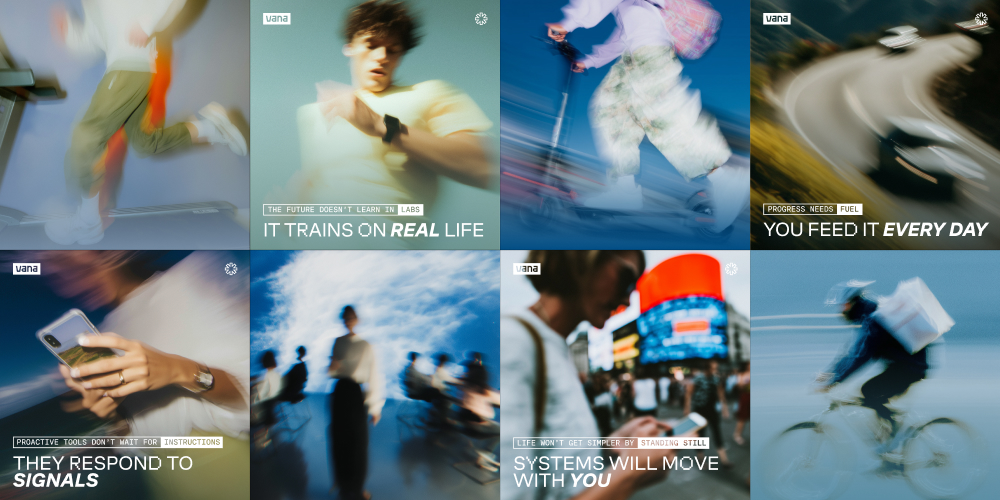
Vana is building infrastructure for data sovereignty; user-owned data working for the user. The first foundation model trained on data that people actually chose to contribute. I spent a year there as Creative Director. I'm staying connected in an advisory role, but my focus is now on expanding the studio.
A year inside Vana's world, AI infrastructure, data governance, the politics of who benefits, recalibrated how I think about creative work. Not because I was studying it from the outside, but because I was inside it. Helping build systems where AI serves the people who feed it, rather than the other way around.
I keep hearing anxiety in creative circles about AI, understandably. But most of it feels slightly misdirected. The real risk isn't replacement. Without human taste directing it, AI produces the statistical average of what it's been trained on. It needs us to decide what's worth making.
When execution becomes cheap and near-instant, something else becomes scarce. Judgement. Taste. The ability to look at ten options and know which one feels right, and why.
AI-heavy creative workflows tend toward homogenised output. Human creative input is the only consistent counterweight I've seen.
the studio
Aran Labs has been my design studio for a few years, going back to my time working with SOPHIE. It started as a creative direction practice, a handful of ongoing design clients and a small team.
Now I'm developing that further. Same lean core, plus a growing system of specialised AI agents, and a simple thesis: when production is abundant, judgement becomes the value.
We're still doing client work. Brand systems. Product design. Creative direction. But we keep seeing product opportunities inside the workflows we're already running, and we're taking them. The internal marketing engine becomes a skill other teams can install. The brand onboarding process becomes a productised service. Each workflow we build for ourselves is a potential product for someone else.
The barrier between "I design" and "I build" has collapsed. Designers can now ship products without engineering teams, without raising capital, without waiting.
If the barrier has come down for me, someone who couldn't write a line of backend code a year ago, it's coming down for everyone. Product managers. Marketing leads. Language teachers. Electricians. Anyone who understands their workflow better than an outside engineer ever could is suddenly able to build for that workflow.
The real experts in every vertical can now build for their own problems and the problems of their peers. This is the beginning of a new kind of builder; not technical by training, but close enough to the problem to build the right thing.
what's next
I'll be writing here about the work, the thesis, and what I'm learning as I go, from a non-technical, creative and marketing-focused point of view.
What happens when taste becomes the bottleneck? When anyone with judgement and domain expertise can ship? When the distance between seeing the problem and building the solution collapses to nearly nothing?
I don't have the answers yet. But I'm building inside the questions.
If you want to follow the products and experiments coming out of Aran Labs, subscribe here or find me on Twitter and LinkedIn.
If you're building something ambitious and want creative that doesn't feel generic, we're taking on a small number of founding clients for studio services. Brand systems, product design, marketing, custom AI workflows. Senior-led. Built to outlast the engagement. hello@aranlabs.com